
$1,500.00
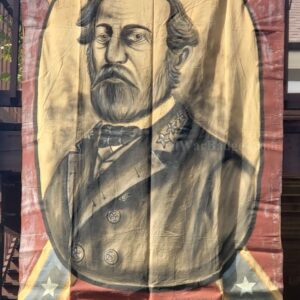
FANTASTIC CONDITION!! measures 4 1/4" x 6 1/2" / blank reverse General Edmund Kirby Smith, whose illustrious career is a notable part of the history of the Confederate war in the West, was born at St. Augustine, Fla., May 16, 1824. His father, Colonel J. L. Smith, a native of Connecticut, then held the office of United States judge for the district of Florida. He was appointed to the United States military academy, was graduated there in 1845, with a lieutenancy in the infantry, and then engaged in the Mexican war, where he received three brevets for gallantry. During his subsequent career as an officer of the United States army he served as assistant professor of mathematics at West Point, 1849-52; was promoted captain of the Second cavalry in 1855; was wounded in a battle with the Comanche Indians in Texas in 1859; and in 1861 was thanked for his services in protection of the State by the Texas legislature and promoted captain by the United States government. With full allegiance to
Out of stock
FANTASTIC CONDITION!! measures 4 1/4" x 6 1/2" / blank reverse General Edmund Kirby Smith, whose illustrious career is a notable part of the history of the Confederate war in the West, was born at St. Augustine, Fla., May 16, 1824. His father, Colonel J. L. Smith, a native of Connecticut, then held the office of United States judge for the district of Florida. He was appointed to the United States military academy, was graduated there in 1845, with a lieutenancy in the infantry, and then engaged in the Mexican war, where he received three brevets for gallantry. During his subsequent career as an officer of the United States army he served as assistant professor of mathematics at West Point, 1849-52; was promoted captain of the Second cavalry in 1855; was wounded in a battle with the Comanche Indians in Texas in 1859; and in 1861 was thanked for his services in protection of the State by the Texas legislature and promoted captain by the United States government. With full allegiance to his native State of Florida, he resigned his Federal commission upon the secession of that State, and entered the Confederate service. He was commissioned colonel of cavalry, March 16, 1861; promoted brigadier-general June 17, 1861; major-general October 11, 1861; lieutenant-general October, 1862, and general February 19, 1864. He served as chief of staff to General Joseph E. Johnston, at Harper's Ferry, rendered important service in the organization of the army of the Shenandoah, and having been promoted brigadier- general, was put in command of the fourth brigade of that army. While leading his command into action at Manassas, July 21st, at the critical moment, he fell severely wounded. He subsequently commanded the reserve division of the army, and being promoted major-general, assumed command at Knoxville on March 8, 1862, of the district of East Tennessee, afterward the department of East Tennessee and Kentucky, North Georgia and Western North Carolina. He sent reinforcements to Beauregard at Corinth, and opposed with an inadequate force the Federal advance at Cumberland Gap. After a conference with General Bragg at Chattanooga, July 31st, General Smith advanced into Kentucky with about 6,000 men, defeated a superior force of Federals under General Nelson at Richmond, and after being joined by General Heth with 4,000 men, he designated his command as "The Army of Kentucky," made vigorous efforts to gather supplies and recruits for the Confederate cause, and occupied Lexington, the capital of the State. When Bragg retired after the battle of Perryville, General Smith skillfully withdrew his army from Kentucky. Having been promoted lieutenant-general he was ordered to the command of the Trans- Mississippi department in February, 1863, where he held the general command, from March 7th until the close of the war, of the districts of Louisiana, Texas, Arkansas and Indian Territory. He established headquarters at Shreveport, organized government, shipped large quantities of cotton to Europe, imported machinery, and did much to develop mining and manufacture. He concentrated his forces in defense of the Red River, and when his department was invaded by Banks and Steele, his measures of defense resulted in the decisive victory at Mansfield. On May 26, 1865, at Baton Rouge, he surrendered his army, the last of the Confederate troops to lay down their arms. During his supreme command in the Trans-Mississippi department he was absolutely faithful to the interests of his country, and spurned the personal profit which might easily have been made enormous. Neither in after life did any stress of financial embarrassment ever tempt him to forget that personal honor, that, like his unfailing courtesy, was a supreme characteristic of his nature. After the war he held the presidency of the Atlantic and Pacific telegraph company, was chancellor of the university of Nashville, 1870-1875, and subsequently was professor of mathematics in the university of the South, at Sewanee, Tennessee, until his death, March 28, 1893.